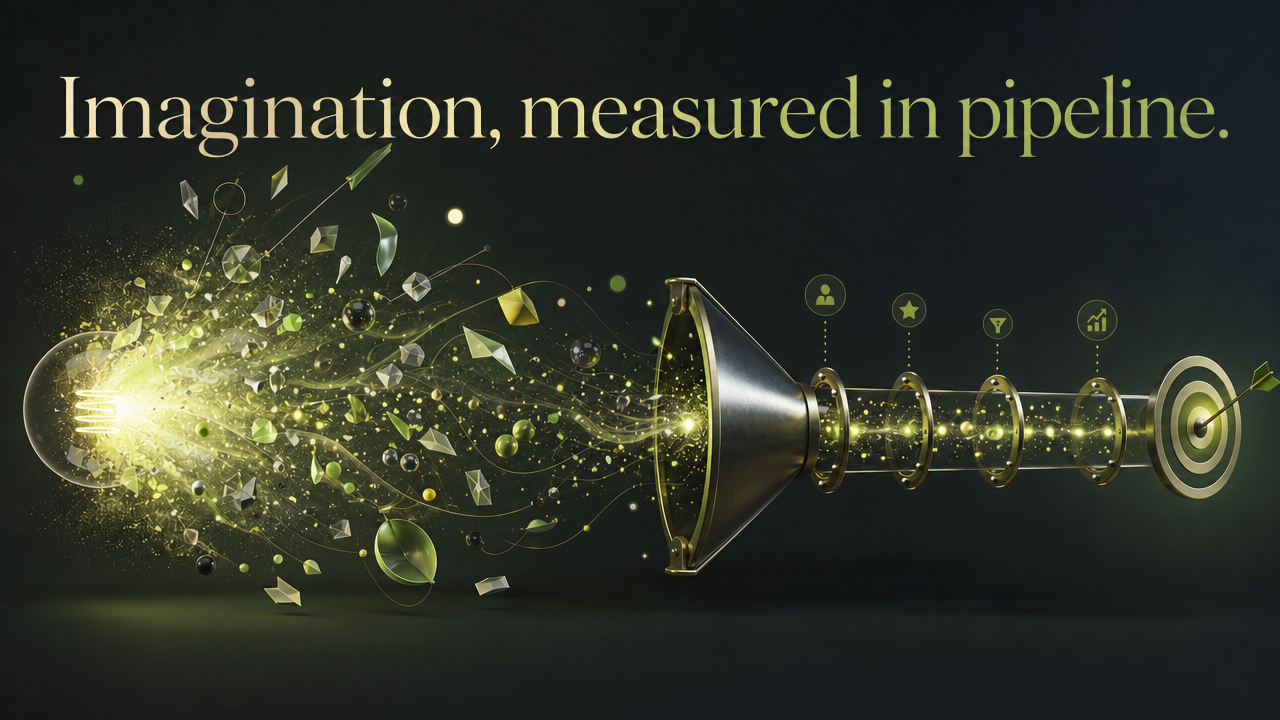
Performance Marketing: Measuring Imagination in Pipeline
Creativity without accountability is decoration. Accountability without creativity is a spreadsheet that slowly stops growing. Performance marketing, done right, is where the two finally work for each other.
There's a myth that performance marketing and brand creativity are opposites — that one is for the artists and the other for the analysts. It's wrong, and in a market like Egypt it's expensive. The brands compounding fastest are the ones that treat imagination as a measurable input and pipeline as the proof it worked. This guide explains how performance marketing actually works for Egyptian brands, and how we run it at What If.
What performance marketing actually is
Performance marketing is a data-driven discipline where every pound of spend is connected to a measurable outcome — a sale, a lead, a sign-up, an install — so you can optimise toward profit in near real time. It spans far more than ads: creative, landing pages, conversion rate optimisation (CRO), analytics, email and retention all sit inside it. Media buying is one part; performance marketing is the whole machine that turns attention into revenue.
The funnel, honestly
Forget the textbook funnel for a moment. In practice you're managing three jobs at once:
- Demand creation — making people want what you sell who didn't this morning. This is where brand and creative live, and it's what makes everything downstream cheaper.
- Demand capture — converting people already in-market efficiently (search, retargeting, high-intent audiences).
- Demand retention — keeping and growing customers you already paid to acquire, which is where real profit hides.
Brands that only do capture hit a ceiling fast: they harvest existing demand until it's exhausted, then watch costs climb. Sustainable growth needs all three.
We measure imagination in pipeline, not impressions.
The metrics that matter (and the ones that lie)
Vanity metrics — impressions, reach, even clicks — feel like progress and often aren't. The numbers that tell the truth:
- CAC — cost to acquire a paying customer.
- LTV:CAC ratio — lifetime value against acquisition cost. The single best health metric; aim well above 1, ideally 3+ over time.
- ROAS — return on ad spend, judged against your margins, not a borrowed benchmark.
- Contribution margin after marketing — are you actually making money once spend is counted?
- Payback period — how long until an acquired customer pays back their CAC.
What is a "good" ROAS?
There isn't one — and anyone who quotes a universal number is guessing. A high-margin business can thrive at a ROAS of 2; a thin-margin retailer might need 5+ just to break even. Calculate your break-even ROAS from your own unit economics, add the profit you require, and target that. Copying someone else's benchmark is how brands scale themselves into losses.
Creative is the performance engine
Here's what the dashboards won't tell you: in today's auction-driven platforms, creative is the biggest performance variable left. Audience targeting has largely been automated by the platforms; what you control is the idea, the hook, the first second of the video, the clarity of the offer. A stronger creative concept routinely cuts cost-per-result more than weeks of bid tinkering. This is exactly why we refuse to separate design and creative from performance — they're the same job.
Don't forget the destination
You can buy perfect traffic and still lose if it lands on a slow, confusing page. Conversion rate optimisation — page speed, clarity, trust signals, frictionless checkout, mobile-first design (most Egyptian traffic is mobile) — often delivers the cheapest performance gains available, because you're improving the return on traffic you've already paid for.
How to scale profitably
Scaling isn't "spend more." It's "spend more where the maths still works." The loop:
- Establish profitable unit economics at small scale.
- Increase spend gradually while watching CAC and contribution margin — not just ROAS, which can hide rising costs.
- Feed the algorithm a steady stream of fresh creative to fight fatigue.
- Invest in demand creation so capture stays cheap as you grow.
That's performance marketing as a growth system — not a campaign you switch on, but a flywheel you keep turning. The imagination is the fuel; the pipeline is the proof.
Key takeaways
- Performance marketing ties every pound to a measurable outcome — across creative, CRO, analytics and retention, not just ads.
- Run demand creation, capture and retention together; capture-only growth hits a ceiling fast.
- Track CAC, LTV:CAC, ROAS, contribution margin and payback — ignore vanity metrics.
- "Good" ROAS is defined by your margins; calculate break-even from your own economics.
- Creative is now the biggest performance lever — don't separate it from media.
- Optimise the landing experience and scale only where the maths still works.
Frequently asked questions
What is performance marketing?
A data-driven approach where every pound of spend is tied to a measurable action — sale, lead, sign-up or install — so you can track return in near real time and optimise toward profit, making creativity accountable to business outcomes.
What is a good ROAS in Egypt?
It depends on your margins, not a universal number. A high-margin business can profit at a ROAS of 2; a low-margin retailer may need 5+. Calculate your break-even ROAS from your own unit economics and add the profit you require.
How is performance marketing different from media buying?
Media buying is purchasing and optimising ad inventory. Performance marketing is the broader discipline of driving and measuring profitable outcomes across the whole funnel — creative, landing pages, CRO, analytics and retention — with media buying as one component.
How long before performance marketing shows results?
Early signals appear within weeks as campaigns exit the learning phase, but reliable, scalable economics usually take 2–3 months of structured testing to establish. Sustainable results compound over quarters, not days.
What's the “what if” you can't stop thinking about? Tell us, and we'll answer with thinking.
Start the conversation →